After four consecutive ultra-aggressive interest rate hikes, the Federal Reserve began to slow down the pace of interest rate hikes as expected by the market, and at the same time raised the expected level of peak interest rates. It is expected that the highest level of interest rates will exceed 5% after interest rate hikes, suggesting that interest rates will continue to rise in the coming months.
On Wednesday, December 14th, US Eastern Time, the FOMC of the Federal Reserve announced after the meeting that it would raise the target range of the policy interest rate federal funds rate from 3.75% to 4.00% to 4.20% to 4.50%, with a rate increase of 50 basis points. Like the previous three meetings in July, September and November, this interest rate increase decision was unanimously approved by FOMC voting members.
This is the first time that the Fed has slowed down the rate hike since it started the current rate hike cycle in March this year, and it is also the first time that the Fed has raised interest rates by 50 basis points since the beginning of May. Before this week’s meeting, from June to November, the Federal Reserve decided to raise interest rates by 75 basis points for four consecutive meetings, maintaining the largest single rate hike since November 1994.
Of the 19 officials who provided expectations,Only two people expected this time.2023, that is,The policy interest rate will be below 5.0% next year.,A total of 17 officials, accounting for more than 89%, expect.Next year’s policy interest rateWill exceed 5.0%. Among them, ten people expect the interest rate to be between 5.0% and 5.25% next year, five people expect the interest rate to be between 5.25% and 5.50%, and two people expect the interest rate to be between 5.50% and 5.75%. butLast time, no official predicted that the interest rate would exceed 5.0% next year.
This time, there are 14 officials, accounting for nearly 74%.In 2024, that is,The policy interest rate in the following year will be higher than 4.0%.Among them, seven people expect the interest rate to exceed 4.50% and the other seven expect the interest rate to be between 4.0% and 4.25%. Seven people expect the annual interest rate to be between 3.75% and 4.0%, and two people expect the interest rate to be lower than 3.50%.There were only six people last time.Officials who account for more than 31% predict that the policy interest rate will beMore than 4.0%All 13 officials expect the interest rate to be lower than 4.0%.
with regard toIn 2025Policy ofinterest rateLevel, this timeestimateAlso at that timeThere are four people above 3.75%, three more than last time.One of them expects the interest rate to exceed 5.5%, two expect the interest rate to be between 4.0% and 4.5%, and one expects the interest rate to be between 3.7% and 4.0%. This time, it is estimated that there are seven people whose annual interest rate is lower than 3.0% in 2025, and there are ten people who expected it last time.
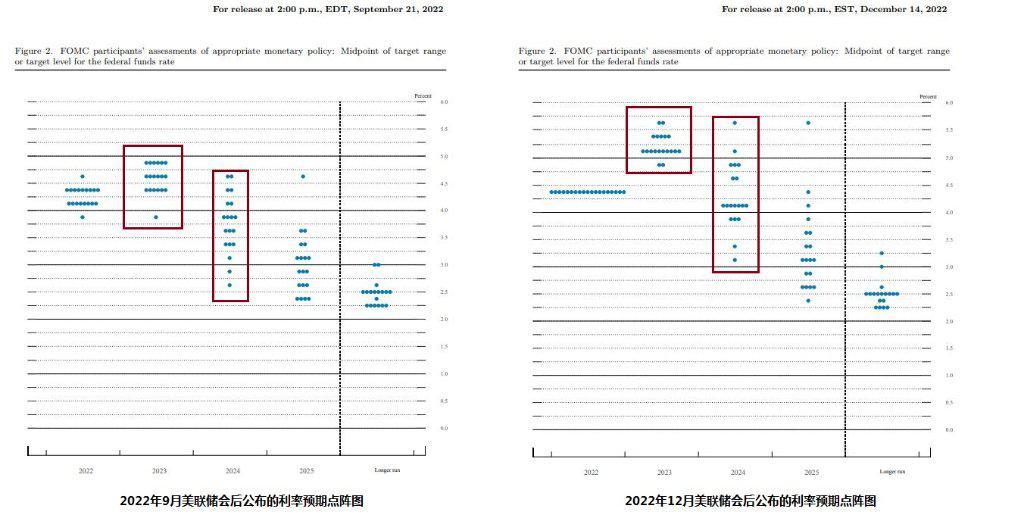
The updated economic outlook released after this meeting shows that Fed officials continue to raise interest rate expectations in 2023, that is, next year and 2024.The median value of the highest interest rate in the three years is expected to exceed 5%.The Fed also raised the expected interest rate level in 2025, showing that the median interest rate will far exceed the Fed’s inflation target by 2%, more than 100 basis points higher than the target.
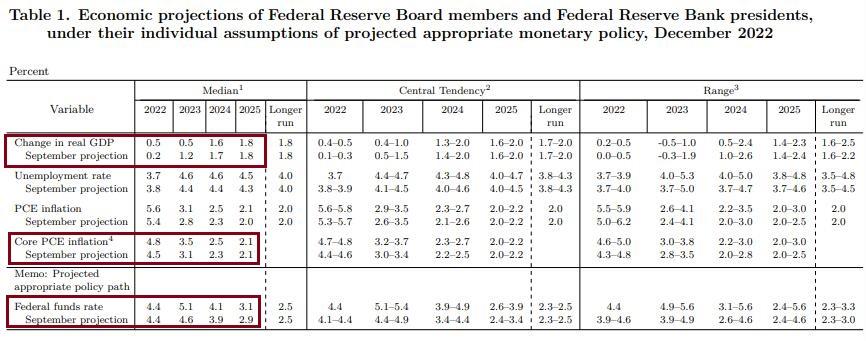
In this economic outlook, the median values predicted by the Federal Reserve are:
- The federal funds rate in 2022 remains unchanged, which is the same as the expected value announced in September, both of which are 4.4%.
- The federal funds rate in 2023 is 5.1%, which is 50 basis points higher than the expected value of 4.6% announced in September.
- The federal funds rate in 2024 is 4.1%, which is 20 basis points higher than the expected 3.9% in September.
- The expected value of the federal funds rate in 2025 is 3.1%, which is 20 basis points higher than the expected 2.9% in September.
The economic outlook also shows that, unlike the last September outlook, the Fed did not continue to significantly reduce its GDP growth forecast this year, but slightly raised it. However, the Fed has continued to cut its growth forecast for the next two years, with the expected growth rate for next year less than half that expected in September.
At the same time, the Federal Reserve lowered its unemployment rate forecast for this year, and the unemployment rate forecast for the three years from next year to 2025 will be raised, and the personal consumption price index (PCE) inflation forecast for the four years from this year to 2025 and the core PCE inflation forecast for this year to the next year will also be raised. Both PCE inflation and core PCE inflation in 2025 are close to the Fed’s inflation target of 2%.
- It is estimated that GDP will increase by 0.5% in 2022 and 0.2% in September. The GDP growth rates in 2023 and 2024 are expected to be 0.5% and 1.6% respectively, and 1.2% and 1.7% respectively in September. The growth rate in 2025 is expected to remain unchanged at 1.8%.
- The unemployment rate is expected to be lowered from 3.8% in September to 3.7% in 2022, from 4.4% to 4.6% in 2023 and 2024, and from 4.3% to 4.5% in 2025.
- PCE inflation rate is expected to be raised from 5.4% in September to 5.6% in 2022, from 2.8% to 3.1% in 2023, from 2.3% to 2.5% in 2024 and from 2.0% to 2.1% in 2025.
- The inflation rate of core PCE is expected to be raised from 4.5% in September to 4.8% in 2022, from 3.1% to 3.5% in 2023, from 2.3% to 2.5% in 2024, and remains unchanged at 2.1% in 2025.
In terms of interest rate guidance, in the resolution statement after this meeting, the Federal Reserve reiterated two new sentences added at the last meeting in November this year. The following two sentences admit that the impact of interest rate hikes is lagging behind, which once ignited the Fed’s steering expectations after the November meeting:
"The (FOMC) Committee expects that in order to keep the monetary policy stance restrictive enough and allow inflation to fall back to 2% over time, it is appropriate for the target range (policy interest rate) to continue to rise.
In order to judge the rising pace of the future target range, the Committee will take into account the cumulative tightening of monetary policy, the lag of monetary policy affecting economic activities and inflation, and changes in the economic and financial situation."
In addition, other contents of the interest rate guidelines remain unchanged. The Fed continues to reiterate that FOMC seeks to achieve the dual goals of full employment and long-term inflation of 2%. After expressing its decision to raise interest rates by 75 basis points to support the above two objectives, the Federal Reserve continued to reiterate its statement in March this year: "The (FOMC) Committee expects that it will be appropriate to continue to raise the target interest rate range."
Statement after this meetingContinue to reiterate the new statement in June.This sentence:
"(FOMC) CommitteeStrong commitment, will let the inflation rate fall back to the goal of 2%."
The statement of this meeting continued to reiterate the expression of the impact of the Russian-Ukrainian conflict first mentioned in the March statement: Russia’s actions against Ukraine "caused great" economic difficulties, but slightly changed the statement since July that "related events of the Russian-Ukrainian conflict are creating new upward pressure on inflation and putting pressure on global economic activities" and changed it to "related events are fuelling upward pressure on inflation and putting pressure on global economic activities".
Immediately after the impact of the above-mentioned Russian-Ukrainian conflict, this statementReiterated the sentence added in May that FOMC is "highly concerned about inflation risks".
When evaluating the economy, this statement continued to reiterate what was said in June, "the employment growth has been strong in recent months, and the unemployment rate has remained low", and continued to reiterate the evaluation of inflation in the March statement:
Inflation remains high, reflecting the imbalance between supply and demand related to the COVID-19 epidemic, rising food and energy prices and broader price pressures.
In May this year, the Federal Reserve announced the route of reducing its balance sheet (shrinking the balance sheet), and reduced its bond positions from June 1, initially reducing at most $30 billion in US Treasury bonds and $17.5 billion in institutional mortgage-backed securities (MBS) every month, and doubling the maximum monthly reduction three months later.
Like the previous four meetings, the statement of this meeting did not reiterate the above line, but said that it would continue to reduce its holdings of government bonds, institutional bonds and institutional MBS according to the reduced table route announced in May.
This article is from Wall Street. Welcome to download the APP to see more.