Machine heart release
Editor: Zenan
The third major change in the mobile phone industry has begun.
Recently, AI and big model technology have advanced by leaps and bounds. Just after the Spring Festival, a new breakthrough has been ushered in the frontier direction.
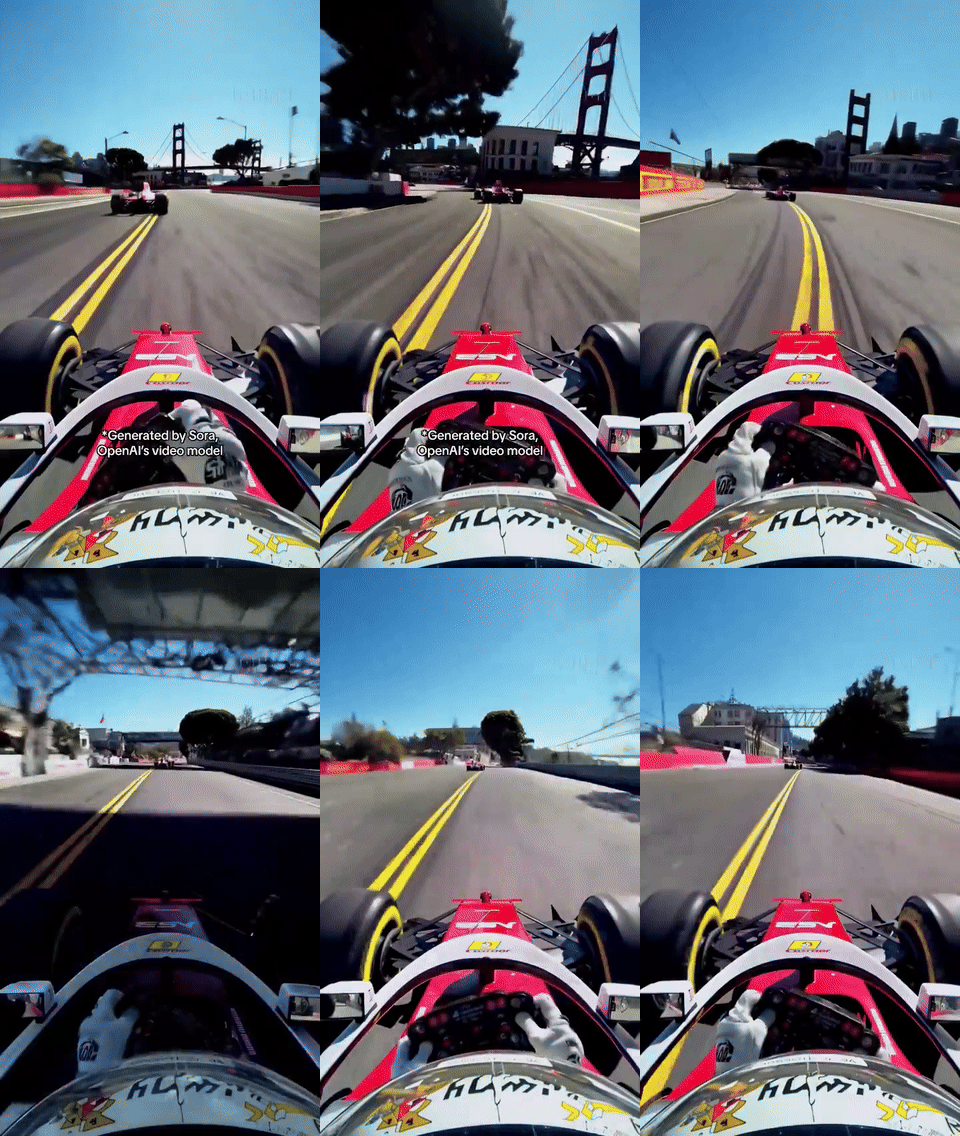
Sora of OpenAI suddenly pulled up the progress bar generated by AI video for half a year.
In the application field of large model, the speed of technology landing application is also accelerating. At present, a new generation of flagship mobile phones of major manufacturers have all appeared, and most of them are equipped with large models, which can realize many unprecedented functions.

Image from Qualcomm Snapdragon 8Gen3 promo: https://www.youtube.com/watch? v=0CqtpjlL25w
Why did everyone choose to enter AI in 2024?
The answer seems clear. With the maturity of the large model and the enhancement of the computing power of the chip end-side, mobile phone manufacturers have a clear judgment: 2024 will be the first year of AI mobile phones.
However, in the face of the same goal, each style of play is different: many mobile phones have begun to introduce cloud-based large model applications, and some have realized end-to-end running of small-scale models. Among them, the OPPO Find X7 series, which has landed multiple AI functions, is gaining more and more recognition.
It has achieved many "firsts": Find X7 is the world’s first mobile phone with a 7 billion-parameter large language model.
It is also the first mobile phone that supports AI call summary, allowing users to let AI generate summary with one click after the call is over, and automatically generate to-do items and reminders:
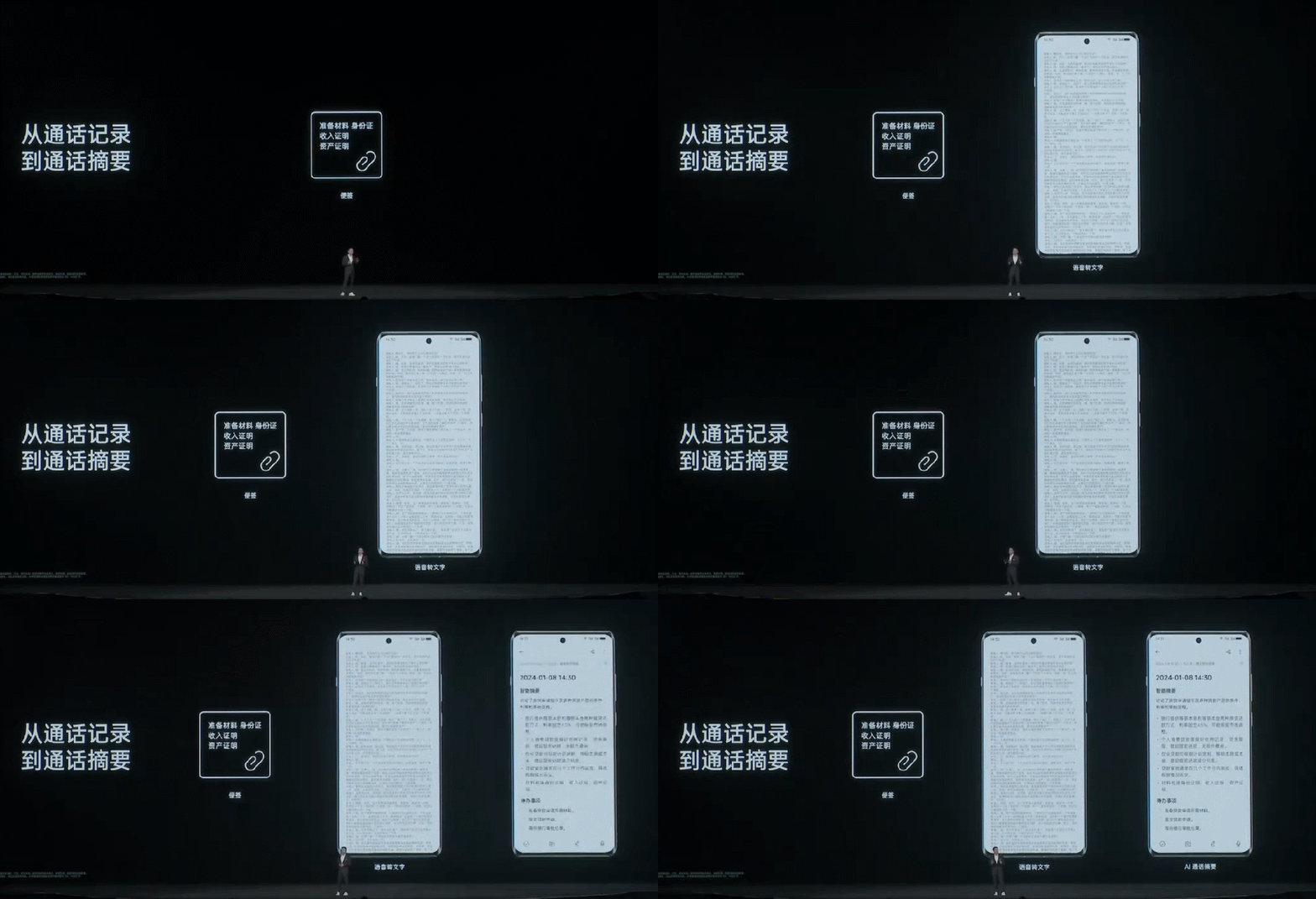
With the blessing of the mobile phone AI model, the smart assistant is no longer a "decoration", and OPPO’s small cloth assistant has achieved a leap-forward experience improvement.
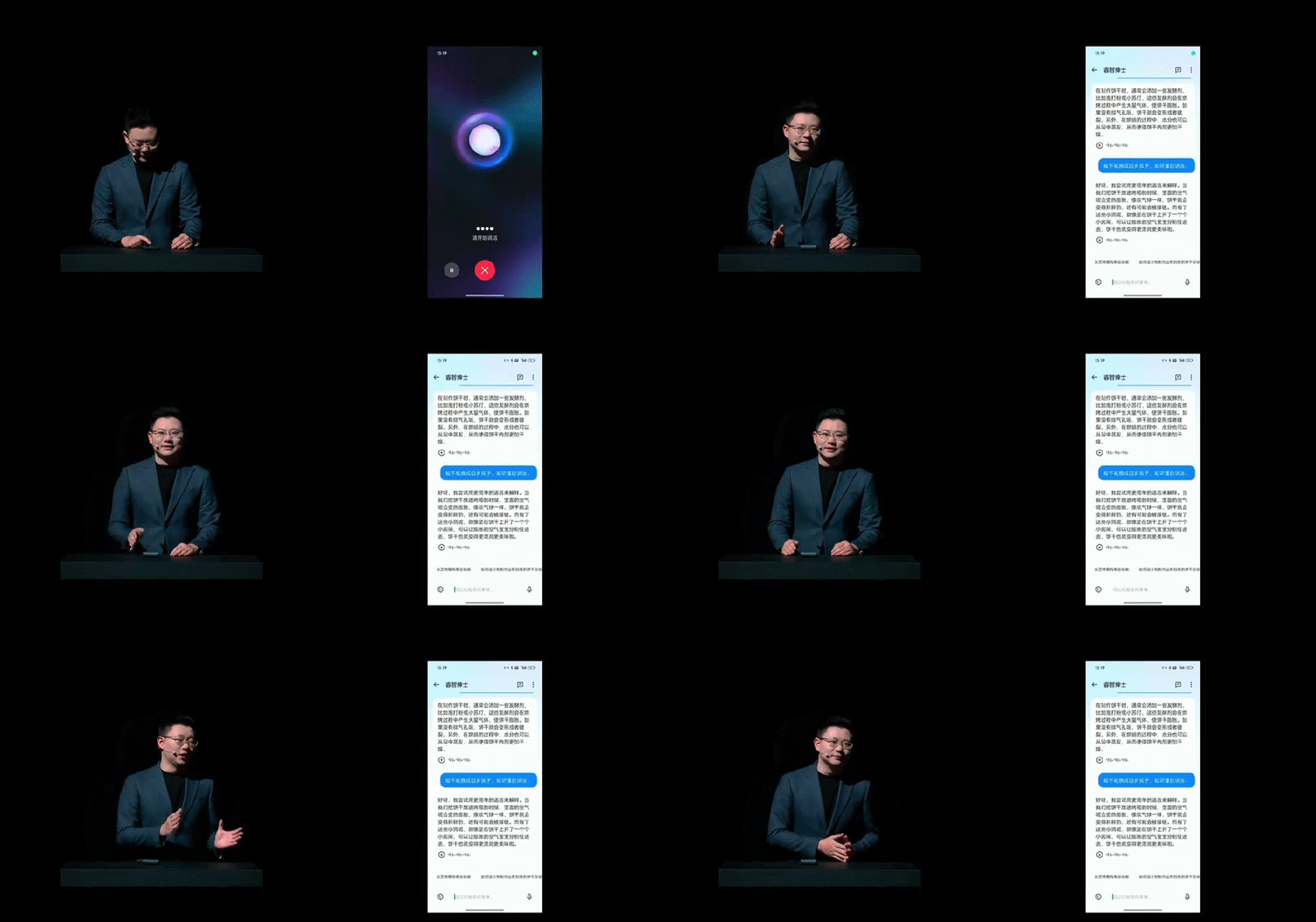
Now Xiao Bu can better understand natural language and answer all kinds of tricky questions. It has more than 100 abilities, including text generating pictures, picture explanation, AI article abstracts, etc., and can help users in different dimensions such as office efficiency, life service, learning and education.
For example, you can ask Xiao Bu why there are many holes in the biscuit and ask him to answer in a way that a four-year-old can understand:
OPPO also brought a new AIGC elimination function. In the past, the task of changing pictures required complicated operation of computer professional software. Now, you only need a simple circle of AI on your mobile phone to help you eliminate the subject and redraw the real scene. In this process, the large model can also be "created" to a certain extent, and the background can be supplemented by the brain to get a picture of the scenery without crowds:
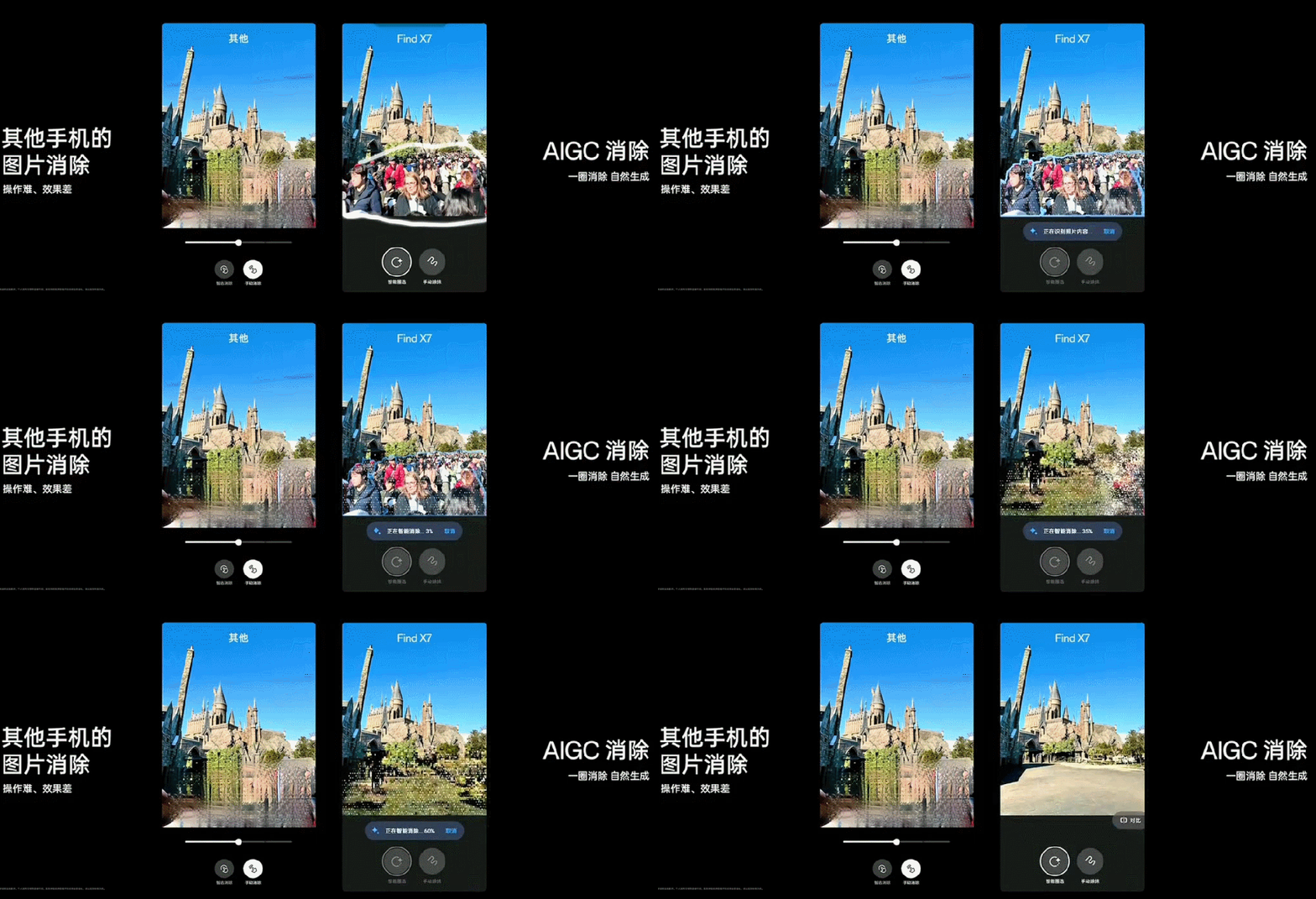
Find X7′ s large model ability not only supports the identification and segmentation of more than 120 kinds of agents, but also can realize hair-level segmentation and multi-agent separation of up to 6 agents. This is the new experience of taking pictures in the era of mobile phone-side generative AI.
As the most common consumer electronic product, mobile phone has always been the priority direction of various AI technologies. AI beauty, AI assistant and other functions have long been the standard of smart phones. With the rise of the big model, the mobile phone, as an "extension organ" of human beings, understands the advantages of users, and with the unprecedented breakthrough of generative AI, it brings more intelligent, personalized experience and more diverse gameplay.
AI mobile phone may be the third major stage of change in the mobile phone industry after functional machines and smart phones. In this revolution, OPPO showed us the new form of mobile phone after the breakthrough of big model technology in advance.
End-side 7 billion parameter large model
Why did OPPO do it?
Many new capabilities that OPPO Find X7 can achieve benefit from the 7 billion-parameter large model running on the end side.
On this generation of flagship machine, the AndesGPT 70 billion parameter model trained by OPPO is equipped for the first time. Through the deployment of end-cloud collaboration, it has achieved an AI experience that is ahead of more than one generation. Compared with the 1 billion parameter model, this model can show a higher "IQ" understanding ability, and can understand the dialogue content more accurately and generate a focused and detailed summary content.
Compared with other models on the same platform, AndesGPT 70 billion parameter version can bring 20 times faster response when generating the first word of 2000 words, and summarize the content of up to 14,000 words, which is 3.5 times that of other models, and the dialogue experience is closer to the speed and information of human dialogue.
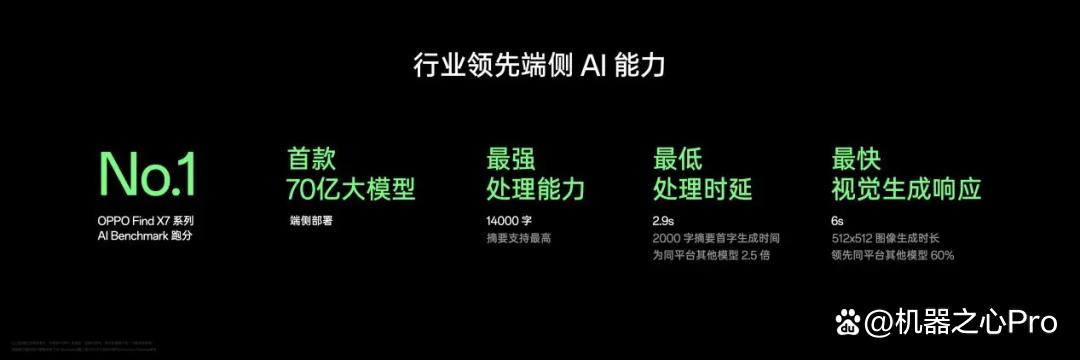
We know that in the current big model arms race, various technology companies are snapping up GPUs. After all, running a big model is very computationally expensive. It is not easy to run a large model on a mobile phone with limited computing power and memory. How does OPPO do it?
This is because on the new generation of mobile phones, OPPO has achieved a comprehensive optimization for the big model, from software and hardware to the cloud platform.
First of all, OPPO cooperates closely with platform manufacturers. Based on the understanding of the chip and the insight and understanding of the user’s needs, the SoC chip is customized according to the large model and algorithm depth, which improves the operation scheduling of the chip under high load conditions and further optimizes the operation efficiency of the large model.
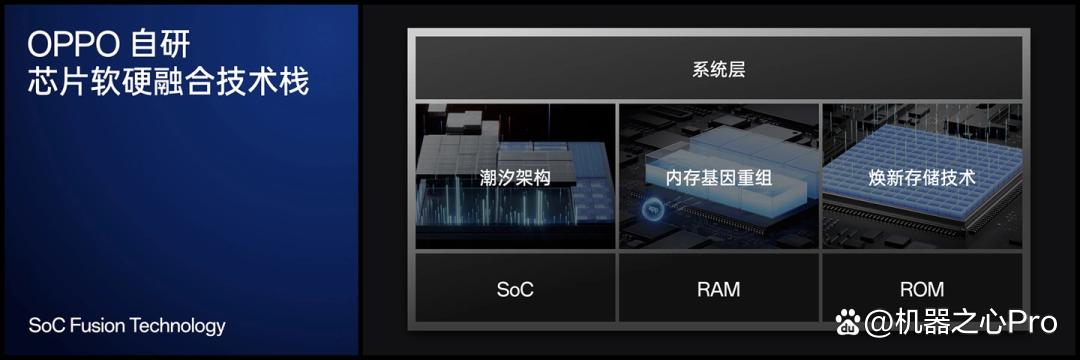
Insight and understanding of users’ needs is the core competitiveness of OPPO, and call intelligence summary is a good example: total recall is a function that has already appeared in the industry, but the combination of traditional total recall and end-to-end big model brings a brand-new AI experience that subverts traditional applications.
The large model is deployed on the end side, and besides the extreme optimization of computing resources, another bottleneck lies in storage.
Under normal circumstances, a large model with 7 billion parameters needs to occupy 28GB of memory. In order to truly realize the end-side deployment, OPPO has greatly compressed the model with the quantization of INT4, so that the model that originally occupied 28GB of memory now only needs 3.9GB, which not only reduces the resource requirements, but also hardly affects the output effect of the AI model.
"The performance consumption of large models is relatively high at the end side, so it is necessary to reduce the loss and system resource occupation by optimizing the operators of parallel computing and memory management. In terms of battery life, according to the use of the aircraft, the power consumption control of our end-side large model is within the acceptable range of users, "said Zhang Jun, product director of OPPO AI Center.
OPPO is also the first mobile phone manufacturer to truly deploy the 7 billion-parameter end-to-end model on two different platforms, Qualcomm and MTK, which "treats users equally" and also verifies its ability to optimize the deployment of AI. At present, the mobile phone deployment of the end-to-end visual model is also listed on their schedule.
For the generative AI capability, sometimes the complex tasks that the end-side model can’t handle need to transfer the data to the cloud and use the power of the server-side AI accelerator; And a lot of information containing personal information and preferences needs to be pre-processed on the mobile phone side to ensure privacy.
The end-cloud collaboration of large models is the consensus of the industry at present.
In this respect, when OPPO released the AndesGPT big model, it proposed the end-cloud joint deployment through the three-level big model deployment strategy, which satisfied the efficient adaptation of multiple scenarios.
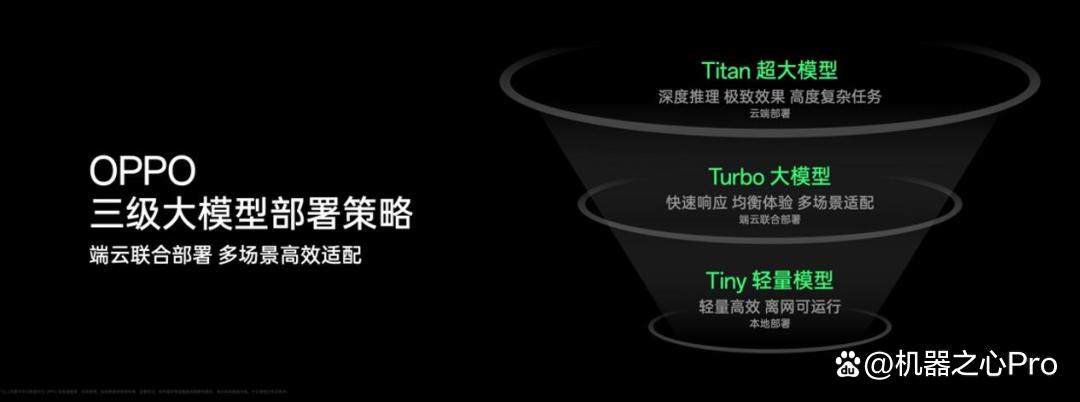
Under the architecture of end-cloud collaboration, the computing power supply of OPPO AI mobile phone is no longer limited to the local area, and at the same time, the user information can be guaranteed not to be leaked-the user data is only calculated at the end side, and the cloud’s more powerful computing power is oriented to complex tasks, which not only improves the overall performance and efficiency of large-scale model calculation, but also ensures security.
In addition to AI technical capabilities, OPPO has a big strategy.
Plus AI strategy
There is no upper limit for artificial intelligence investment
In fact, OPPO has been deeply involved in the AI field for many years: as early as 2020, OPPO began to explore the training, application and landing of large-scale language models, and OBERT, the first self-developed large-scale model, once ranked first in the Chinese large-scale knowledge map quiz KgCLUE list; In 2023, OPPO’s self-trained Andean Grand Model (AndesGPT) was second only to GPT 4 in the ranking of Super CLUE knowledge and encyclopedia ability, ahead of all competing products.
In addition, the 7 billion models applied on the end side of Find X7, AI computing power running score also ranked first on the Android list.
Chen Mingyong, founder and CEO of OPPO, judged that 2024 will be the first year of AI mobile phones, and the impact of AI on the mobile phone industry in five years will not be ignored.
On February 20th, OPPO held an AI strategy conference and shared their detailed planning on AI strategy.
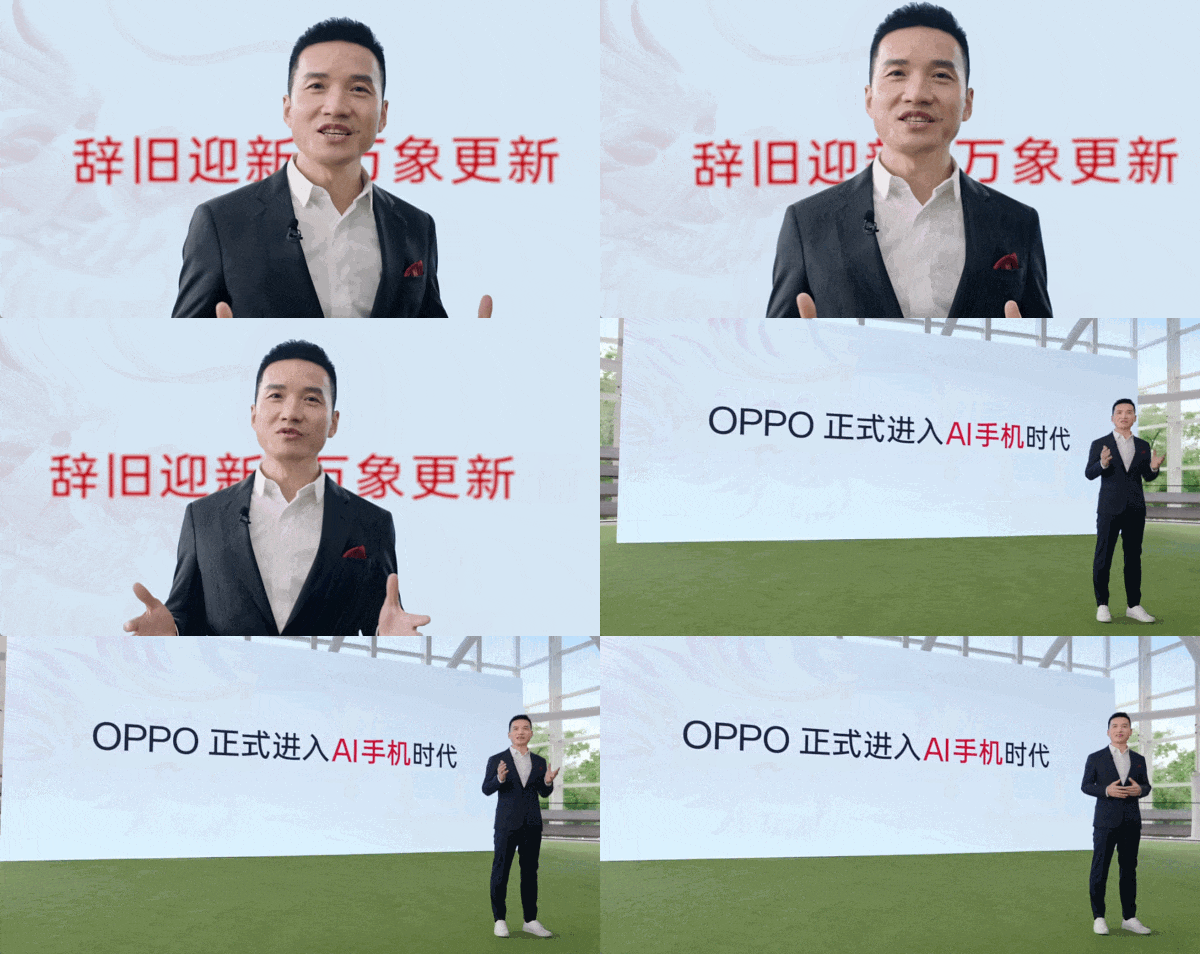
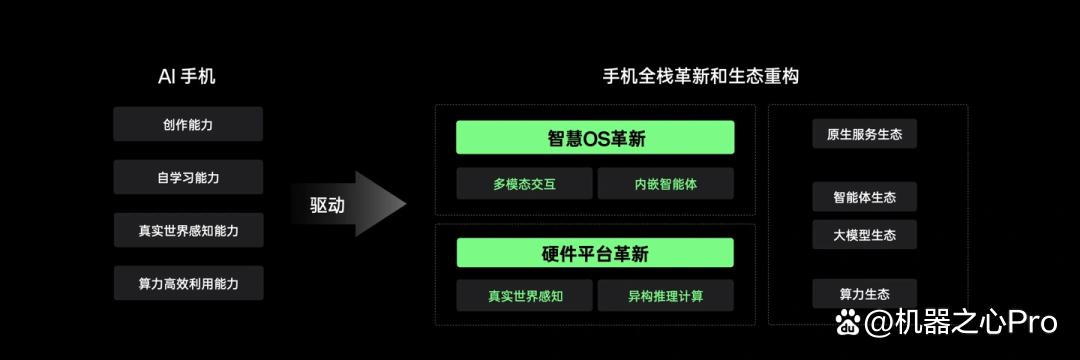
OPPO defines a real AI mobile phone and thinks that it needs to have the following four characteristics:
-
It can make efficient use of computing resources and meet the computing needs of generative AI.
-
Can keenly perceive the real world and understand the complex information of users and the environment;
-
Strong self-learning ability;
-
Have more abundant creative ability, and provide continuous inspiration and knowledge support for users.
In order to meet these requirements, the mobile phone industry needs to carry out comprehensive technological innovation and ecological reconstruction: in terms of hardware architecture, high-efficiency AI computing base, model base management optimization and intelligent bionic perception will become the new standards of AI mobile phones. The OS system of AI mobile phone will be able to handle complex tasks efficiently and create actively by embedding agents.
On the other hand, the future AI mobile phone will support more acute and accurate natural semantic understanding, have more powerful self-learning ability, and provide more intuitive multimodal interaction. From this point of view, the traditional application ecology will turn to the agent ecology in the era of AI mobile phones, and all kinds of service applications will be seamlessly connected with AI capabilities to realize truly intelligent services.
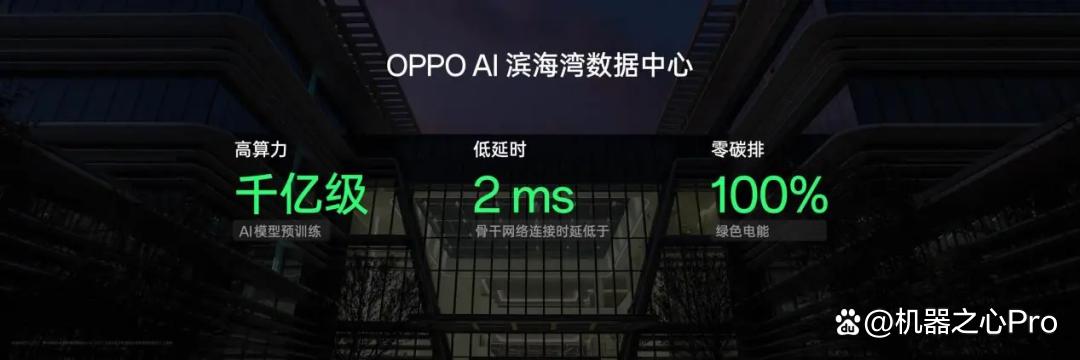
To this end, OPPO has made sufficient preparations. In terms of cloud computing power, OPPO has an OPPO AI marina bay data center that can support the training of hundreds of billions of AI models, support the ultra-low latency of two milliseconds backbone network links, and 100% pure green energy.
In the future, OPPO will continue to invest in computing power and deploy AndesGPT Titan, Turbo and Tiny models to correspond to different application scenarios.
In terms of Agent capability, OPPO officially released the 1+N agent ecological strategy. Among them, "1" stands for OPPO AI super agent, which is based on knowledge map, document data and search engine, can accurately understand the user’s intention, give accurate results, and fully call other tools; "N" represents a brand-new agent ecology empowered by the OPPO AI Pro agent development platform.
Compared with the big model intelligent assistant, the agent is a faster and more active AI assistant, which can accomplish various goals in the most effective way according to your settings, and meet the needs of emotional companionship, knowledge exploration, entertainment and small talk. At the same time, the method of building an agent is very simple, and there is no need for programming code foundation. People only need to have a natural language dialogue with the big model and provide necessary explanations and knowledge.
Agents can also be connected with other services outside the big model, access more information and mobile phone functions, and meet various needs of users with universal capabilities.
More importantly, OPPO’s 1+N also means uniting more partners and developers. With the development of agent layout, people can jointly create a service system for the AI mobile phone ecosystem.
Just like the APP application market on smartphones. But this time, the service connected by AI is more capable and more closely connected with you.
OPPO continues to add AI. At the strategic conference, OPPO officially announced the establishment of the AI Center, aiming at integrating R&D resources and conducting capacity building and R&D for AI. Liu Zuohu said that the establishment of AI Center will gather the strength of the whole company, and AI has been regarded as the most important strategy in the next era of mobile phones, with no upper limit on investment.
Mobile phone blessed by big model
How will it evolve?
This is just the beginning. After all, the big model is a "world-changing" technology, and applications in all fields must be redone with AI.
Recently, in artificial intelligence, many people have made big moves: Apple stopped its car-making project that lasted for many years and shifted its exploration focus to generative AI; When Google released the native multi-modal big model Gemini, it announced that the big model will be integrated into Android in the future; The new generation AI Hub launched by Qualcomm at the MWC conference has supported the end-side acceleration of more than 75 mainstream AI models. Now, from mobile phone manufacturers to technology companies to chip companies, great minds think alike.
We can foresee that with the progress of technology and the construction of industry ecology, we will see more intelligent photos, faster human-computer interaction, more personalized content generation and more efficient task processing in the future.
Using generative AI, the complicated work in the past will become simpler. People can let AI automatically complete complex tasks without opening professional software, which greatly improves work efficiency.
The generative AI deployed on the end side can also make the smartphone know more about the user’s habits and location. Using situational information, digital assistants will be more personalized, bring more satisfactory answers and provide more active services.
Furthermore, with the AI generation capability gradually entering the multi-modal field, the next generation AI rendering tools will be able to generate 3D objects and scenes with various types of prompts such as text, voice, image or video, and finally create a new immersive content experience.
In a word, AI mobile phones will bring us a revolution.

With the continuous promotion of AI technology by mobile phone manufacturers such as OPPO, the distance between us and imagination is close.