Beijing, Sept. 29 (Reporter Zhang Ni) Recently, the sudden death of Beijing subway passengers attracted public attention. According to the statistics of National Cardiovascular Center in 2019, the number of sudden cardiac death in China is as high as 550,000 every year. According to the data, the number of cardiovascular patients in China is estimated to reach 330 million.
On September 29th, World Heart Day came. How much do you know about heart health?
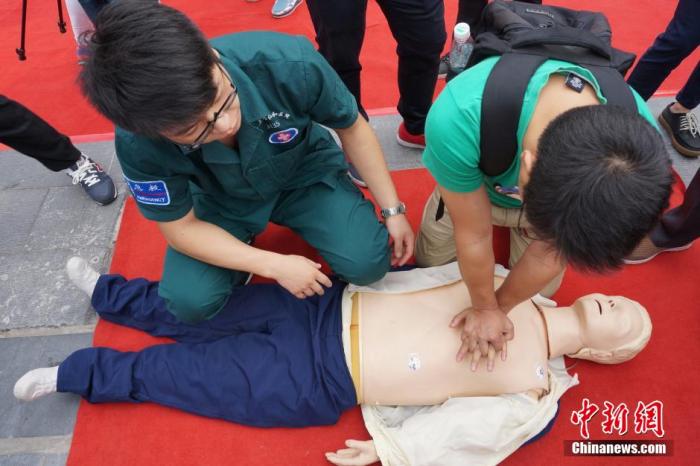
Data Map: A student learns CPR with the help of volunteers. Photo by Dong Xiaobin
The number of cardiovascular patients in China is 330 million.
In 2019, The Lancet published such a study — — After analyzing the causes of death of China residents from 1990 to 2017, it is found that the first death rate is stroke, followed by ischemic heart disease, and the third is lung cancer.
According to the China Cardiovascular Health and Disease Report 2019 recently released by the National Cardiovascular Center, the number of cardiovascular patients in China is 330 million, including 13 million stroke, 11 million coronary heart disease, 5 million pulmonary heart disease, 8.9 million heart failure, 2.5 million rheumatic heart disease, 2 million congenital heart disease, 45.3 million lower extremity arterial disease and 245 million hypertension.
The study also shows that the mortality rate of cardiovascular disease in rural areas has exceeded and continuously exceeded the urban level since 2009.
China Cardiovascular Disease Health and Disease Report 2019 emphasizes that at present, cardiovascular disease deaths account for the first place in the total death causes of urban and rural residents, with 45.91% in rural areas and 43.56% in urban areas.
According to the Report, with the development of social economy, the national lifestyle has undergone profound changes. Especially with the aging of population and the acceleration of urbanization, the prevalence trend of cardiovascular risk factors in China is obvious, which leads to the continuous increase of the incidence of cardiovascular diseases. The number of patients with cardiovascular diseases will continue to increase rapidly in the next 10 years.

Data Map Photo by Chen Chao
Hypertension, obesity, smoking … …
How many of these risk factors do you account for?
Cardiovascular and cerebrovascular diseases are characterized by high morbidity, disability, recurrence and mortality, which bring heavy social and economic burdens.
Studies have shown that hypertension, dyslipidemia, diabetes, obesity, smoking, lack of physical activity, unhealthy eating habits and so on are the main risk factors of cardiovascular and cerebrovascular diseases that can be changed.
Previously, Gao Runlin, an academician of China Academy of Engineering and a professor at Fuwai Hospital of China Academy of Medical Sciences, issued a reminder in combination with the China Cardiovascular Disease Health and Disease Report 2019: Tobacco use, reasonable diet, physical activity, overweight and obesity, healthy psychology and other factors should be given priority attention as the main influencing factors of Chinese cardiovascular health.
The above Report shows that from 1992 to 2012, the dietary structure of China residents changed significantly. The average carbohydrate function ratio decreased from 66.2% to 55.0%, and the fat function ratio increased from 22.0% to 32.9%.
But correspondingly, the overall physical activity level of Chinese people has decreased, and overweight and obesity have increased. From 1991 to now, the total physical activity of adults has dropped by nearly half. From 2016 to 2017, although the physical activity compliance rate of primary and secondary school students in China has increased to a certain extent, from 29.9% to 34.1%, the growth is mainly concentrated in the primary school and junior high school students, and there is no change in the high school stage.
From 2002 to 2012, the overweight rate of residents over 18 years old rose from 22.8% in 2002 to 30.1%, and the obesity rate rose from 7.1% to 11.9%.
Gao Runlin emphasized that studies have confirmed that obesity, overweight and lack of exercise are high-risk factors for cardiovascular diseases. The pessimistic trend revealed in the Report suggests that people should develop a more active and healthy lifestyle in terms of eating habits and physical activities.
The harm of smoking to the heart can not be ignored.
Besides eating habits, smoking, depression and other factors will also increase the risk of heart disease.
Research shows that the prevalence of depression in patients with acute myocardial infarction in China is 21.66%, which is significantly higher than that in healthy people (10.36%). A prospective study on chronic diseases in China found that the prevalence rate of major depression in China residents was 0.6%, and major depression was one of the risk factors of heart disease.
On the 22nd of this month, the World Health Organization, the World Heart Federation and the University of Newcastle, Australia jointly released a report, which showed that 1.9 million people worldwide died of heart disease caused by tobacco every year. This number has increased by more than 200,000 in just 20 years.
The report warns that one fifth of heart disease deaths are caused by tobacco, urges all smokers to quit smoking to avoid heart attacks, and emphasizes that smokers are more likely to suffer from acute cardiovascular diseases than non-smokers.
In China, the adult tobacco survey in China in 2018 showed that the smoking rate of people aged 15 and above was 26.6%, including 50.5% for men and 2.1% for women. Although from 2010 to 2018, the smoking rate of people aged 15 and above in China showed a downward trend, tobacco control still needs to be strengthened.

Data map: Aerobics performance. Photo by Lu Ming
To prevent cardiovascular and cerebrovascular diseases, you need to know these!
Prevention and treatment of cardiovascular and cerebrovascular diseases is not only related to personal health, but also rises to the strategic level of healthy China.
"Healthy China Action (2019— 2030) has clearly put forward such a goal — — By 2022 and 2030, the mortality rate of cardiovascular and cerebrovascular diseases will be reduced to 209.7/100,000 and below and 190.7/100,000 and below respectively.
As individuals, how can we prevent such diseases?
— — Know one’s blood pressure
Adults aged 18 and above regularly monitor their blood pressure, pay attention to the changes of blood pressure and control the risk factors of hypertension. Overweight or obesity, high-salt diet, smoking, long-term drinking, long-term mental stress and insufficient physical activity are the high-risk groups of hypertension.
It is suggested that people with normal high blood pressure (120 ~ 139 mmHg/80 ~ 89 mmHg) should pay attention to controlling the above risk factors as soon as possible. It is suggested that people with normal blood pressure should measure their blood pressure at least once a year, and high-risk groups should measure their blood pressure frequently and receive health guidance from medical staff.
— — Self-blood pressure management
Systolic blood pressure ≥ 140mmHg and/or diastolic pressure ≥ 90mmHg can be diagnosed as hypertension. Patients with hypertension should learn self-health management, take medicine seriously according to the doctor’s advice, and often measure their blood pressure and make follow-up visits.
— — Pay attention to reasonable diet
It is suggested that people at high risk of hypertension and patients should pay attention to the intake of dietary salt, the daily intake of salt should not exceed 5g, and abstain from drinking, reduce the intake of foods rich in oil and sugar, and limit the consumption of cooking oil.
— — Exercise according to one’s ability
It is suggested that people at high risk of cardiovascular and cerebrovascular diseases (with a past history of cardiovascular and cerebrovascular diseases or abnormal blood pressure and blood lipid, or according to the Guidelines for Cardiovascular Risk Assessment and Management issued by the World Health Organization, judge the risk of cardiovascular and cerebrovascular diseases in 10 years ≥ 20%) and the exercise form of patients are determined according to personal health and physique. Cardiovascular and cerebrovascular risk assessment should be considered, and the exercise limit should be considered in all directions. Aerobic endurance exercise with large muscle groups, such as walking, jogging, swimming, Tai Ji Chuan and other exercises, should generally reach moderate intensity.
— — Pay attention to and regularly check blood lipids.
People under the age of 40 with normal blood lipids should have their blood lipids tested once every 2 to 5 years. People aged 40 and above should be tested for blood lipids at least once a year. Blood lipids of high-risk groups of cardiovascular and cerebrovascular diseases are tested once every 6 months.
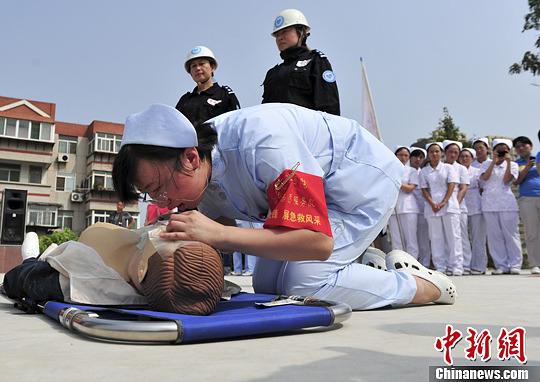
Data Map: Volunteers conduct first aid drills. China News Agency issued Zhang Yong photo
— — Prevent the occurrence of stroke
The increase of stroke incidence and mortality is closely related to the increase of blood pressure. The higher the blood pressure, the higher the risk of stroke. There is a significant correlation between dyslipidemia and the incidence of ischemic stroke. Atrial fibrillation is an important cause of ischemic stroke. Lowering blood pressure, controlling blood lipids and maintaining a healthy weight can reduce the risk of stroke. It is suggested that patients with atrial fibrillation should be treated with anticoagulation according to the doctor’s advice.
— — Learn to master self-help measures and emergency medical guidance.
The pain parts of acute myocardial infarction (precordial area, posterior sternum, subxiphoid process, left shoulder, etc.) are the same as angina pectoris, but they last for a long time and are severe, and may be accompanied by symptoms such as nausea, vomiting, sweating, etc. Patients should be allowed to stay in bed absolutely, loosen the neckline, and keep quiet and air circulation indoors. Those who have the conditions can take oxygen immediately, take 1 piece of nitroglycerin under the tongue, and call the emergency center immediately. Do not take the bus or help the patient walk to the hospital.
Early stroke is characterized by sudden weakness or numbness of one limb, sudden inability to speak clearly or understand others’ speech, sudden rotation and inability to stand, transient visual impairment, black eyes, blurred vision, unbearable headache, gradual aggravation or persistence of symptoms, accompanied by nausea and vomiting.
When this happens, the patient should be laid flat, supine, without a pillow, and his head should be tilted to one side, so as to keep the patient warm. At the same time, call the emergency number immediately and get to the hospital as quickly as possible. Grasping the golden rescue time window of 4 hours and receiving intravenous thrombolytic therapy can greatly reduce the mortality and disability rate.