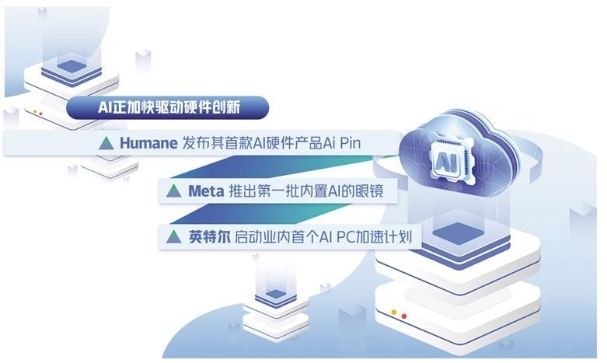
With the development of generative artificial intelligence (AI), hardware innovation is becoming a new business opportunity. On November 10th, Humane, an American technology company, released its first AI hardware product, Ai Pin. This new product, which can be pinned to clothes like a pin and is the size of an egg, can realize functions such as taking photos, making phone calls and translating in real time, and is regarded as a challenger of smart phones. AI is accelerating the innovation of driving hardware, and a large number of new intelligent products of AI hardware will be born in the future.
From the perspective of technological innovation, this is an innovative exploration to push AI from "concept" to "landing". Ai Pin not only sets up sensors, but also carries the AI model developed based on GPT-4, and also innovates the interaction mode. Instead of setting a screen like a mobile phone, it uses laser projection to project the display interface on the palm of your hand, which can be controlled by clicking, gestures and voice commands. You can search and query by moving your finger, receive messages by spreading your palm, and automatically estimate the nutritional composition of a handful of almonds on your palm … The new interactive mode has broken through the existing traditional mode represented by touch screen.
Humane officially claims that the purpose of Ai Pin is to replace mobile phones, but will the rapid development of AI hardware really replace mobile phones? It’s difficult at present. Although it is positioned as "AI Personal Assistant", its functions are still relatively basic. The functions displayed by Ai Pin at the press conference include voice call, real-time translation, food identification and nutrition information, restaurant and music recommendation, etc. Many of these functions can be realized by mobile phones, and the substitution of Ai Pin is not strong. There is still a long way to go to innovate and unlock more AI functions in the future.
However, although AI hardware may not subvert the mobile phone at present, it reflects that the basic technical conditions for developing and designing a new generation of intelligent hardware products have gradually matured, and the development and use of AI functional services is becoming a trend. For example, the development of 5G can support more efficient mobile network operation and reduce the cost of data transmission, thus making it possible to popularize and apply more complex interaction modes on a large scale; The rapid upgrade of iterative AI chips improves the ability to deal with intensive generative artificial intelligence loads, and can effectively solve the problem of "computing power shortage".
The "new entrance" to access AI is spreading from the mainstream PC and mobile phone to a wider range of hardware devices. AI, which was originally confined to science fiction works, has moved to the application layer in various ways. Previously, Meta, the parent company of Facebook, launched the first batch of glasses with built-in AI at the 2023 developer conference, and proposed the combination or future trend of "MR+AI+ smart glasses". Intel recently announced the launch of the industry’s first AI PC acceleration program, and plans to introduce AI performance into more than 100 million PC devices by 2025. At the same time, smartphones are also accelerating AI. Apple is constantly increasing its research and development of generative AI, and is committed to introducing generative AI technology into the mobile terminal.
With smart terminals cutting into user scenarios, AI-driven hardware innovation is accelerating. We expect that in the future, AI hardware can truly become an "AI assistant" with deeply embedded AI functions, accurate understanding of users’ individual needs and self-learning ability. (Yajun Sun)