China launched the first national comprehensive risk survey of natural disasters. How can billions of data protect your safety and mine?
In late March, on the seashore wetland of chen dai zhen, Jinjiang City, Quanzhou City, Fujian Province, a large area of mangroves formed a green "city wall" along the coastline, resisting the invasion of waves on the embankment.
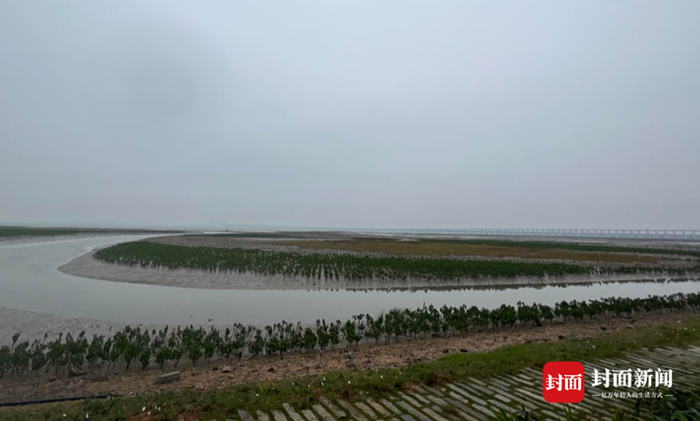
Mangroves at the seaside of chen dai zhen, Jinjiang City, Quanzhou City, Fujian Province. Cover journalist Dai Rui photography
This is a young mangrove with an average age of less than two years. Their appearance is related to the first national comprehensive risk survey of natural disasters. On May 31, 2020, the General Office of the State Council issued the Notice on Carrying out the First National Comprehensive Risk Survey of Natural Disasters. In the past three years, nearly 5 million professional and technical personnel participated in the general survey, and obtained billions of national disaster risk factor data.
How will these billions of risk census data be applied? Recently, the cover journalist participated in the first national comprehensive risk survey of natural disasters "media grassroots trip" and learned more about the progress of this work.
Physical examination of comprehensive risk of natural disasters
Provide support for eliminating potential safety hazards in advance
Chen dai zhen, Jinjiang City is located at the bottom of Quanzhou Bay, which was once seriously affected by typhoon and tsunami disasters in history. Zheng Xiaobin, a staff member of the Sea Islands Division of Jinjiang Natural Resources Bureau, recalled that the "3.11" earthquake in Japan in 2011 triggered the Pacific tsunami, which affected the coastal areas of Jinjiang, and the tidal level near chen dai zhen was 55cm higher than the normal level, resulting in the destruction of the natural coastline.
Historical disaster investigation is one of the contents of the first national comprehensive risk survey of natural disasters. According to Zheng Xiaobin, according to the census data, Jinjiang has comprehensively found out the basic situation of marine disasters on the 121-kilometer coastline, formed the first marine disaster risk survey report in Jinjiang, and designated five areas, including the coast near chen dai zhen, as key defense areas for typhoons and tsunamis.
Since January 2021, Jinjiang has spent more than one year planting and restoring 2,912 mu of mangroves. Wang Yuzhi, head of the Department of Ecological Restoration and Geology and Minerals of the Municipal Bureau of Natural Resources, said that mangroves, known as "coastal guards", are the first barriers for coastal ecological protection, and mainly achieve the effect of wave prevention and bank protection through three functions: wave dissipation, slow flow and siltation promotion. According to statistics, the wave attenuation coefficient of mangroves can reach more than 80%, and the obstruction of mangroves to water flow makes the velocity of forest areas only one tenth of that of tidal gullies, and the deposition speed of mangrove beaches is 2 to 3 times that of nearby bare beaches. Therefore, wherever mangroves are distributed in coastal areas, seawalls are not easy to be washed away and economic losses are relatively small.
In Nan ‘an City, Quanzhou City, Fujian Province, the census results were used to promote the investigation and rectification of hidden dangers. Huang Zhenyu, director of the Nan ‘an Census Office and member of the Party Committee of the Emergency Management Bureau, said that the city had identified 776 new potential risks in the census and immediately organized rectification.
"It can be said that this census helped Nan ‘an make a comprehensive ‘ Physical examination ’ " According to Huang Zhenyu, Nan ‘an combines the census data with the grass-roots social governance grid platform. The city has divided 445 first-level grids, 3,372 second-level grids, and more than 13,600 grid members and volunteers. Make full use of "party building+grid", "online+offline" and "civil air defense+technical defense" to expand the application effect of census data, share and share census data, and dynamically update them.
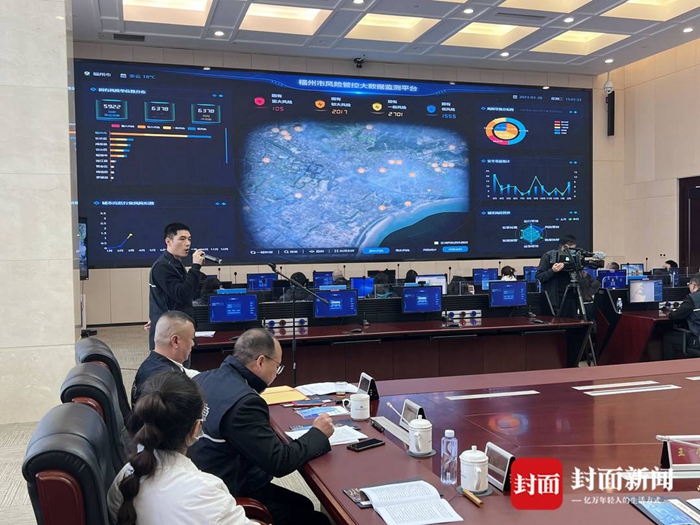
In the emergency command center of Fuzhou City, Fujian Province, the staff is explaining the big data monitoring platform for risk management and control in Fuzhou City. Cover journalist Dai Rui photography
How to apply the results of comprehensive risk survey of natural disasters
Many places "show their magical powers"
Fujian is one of the provinces that have been seriously hit by typhoon disasters in China. Gao Lu, a researcher at the School of Geographical Sciences of Fujian Normal University, said that the census data showed that from 1978 to 2020, 38% of the people who died from disasters in Fujian were caused by typhoons, and the economic losses caused by typhoons accounted for 48%.
In view of the typhoon and rainstorm disaster, the School of Geographical Sciences of Fujian Normal University has built a dynamic risk prediction model of typhoon-rainstorm-flood, in which the data of the first national comprehensive risk survey of natural disasters are applied. In a classroom of the school, Gao Lu demonstrated the working principle of this model to reporters.
He introduced that the risk of waterlogging in Fuzhou urban area can be evaluated by inputting the data of pregnant environment, disaster-bearing body and disaster reduction ability obtained from the census into the model. In order to verify the accuracy of the model, the team has carried out dynamic simulation and case inversion on Typhoon lupit which landed in Fujian in 2021.
For example, the model analysis thinks that the front of a hospital is a high-risk area of waterlogging. At that time, we found that there was indeed waterlogging in this area through field visits, and all the hospital doors were flooded. Gao Lu said that according to the changes of disaster-causing factors such as typhoon path, the model can be evaluated every 12 hours and release disaster-causing risk tips.
Census data can help government departments to make better decisions, such as taking precautions against disaster-stricken high-risk areas before disasters come. Zhang Chengyu, deputy director of Fuzhou Emergency Management Bureau, told the cover journalist that through the first national comprehensive risk survey of natural disasters, Fuzhou found many risk points. For example, some areas are prone to landslides, and some areas are prone to waterlogging, which poses a threat to people’s life safety. The government will transfer people in these areas in advance before the disaster. "It can be said that the census has enabled us to be aware of it and put prevention first."
The reporter noted that at present, many provinces in China have applied the data of the first national comprehensive risk survey of natural disasters. Different from typhoon disasters in coastal areas, Sichuan, which is located inland, has frequent earthquake disasters. Mao Dezhong, deputy director of the Emergency Management Department of Sichuan Province, introduced that Sichuan has made some explorations and practices in promoting the application of census results in natural disaster prevention, economic and social development, social governance and public services based on "fire prevention in winter and spring, flood prevention in summer and autumn, disaster prevention in four seasons and earthquake prevention all year round".
He introduced that the Sichuan earthquake department has widely used the census results in the preparation of the 14 th Five-Year Plan, the site selection of major projects, and the action plan for major earthquakes, providing accurate service guarantee for major planning and earthquake disaster risk prevention for governments at all levels in land space, disaster prevention and mitigation, and industrial development. Chengdu fully integrates the data of census results of various industries and departments, and establishes the application system of risk census results, which is integrated with the comprehensive monitoring and early warning platform of urban safety risks and the construction of "smart Rongcheng" system, providing strong support for the construction of smart cities and grassroots social governance.
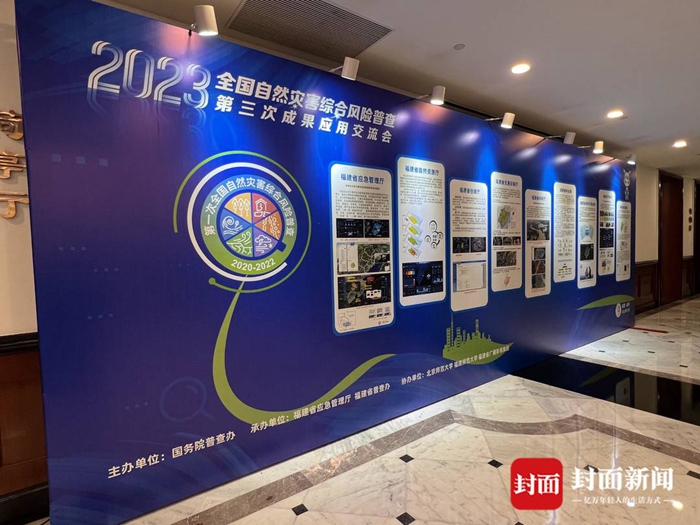
On-site exhibition board of the third application exchange meeting of the national comprehensive risk survey of natural disasters. Cover journalist Dai Rui photography
"Treating the disease before illness"
Census promotes the transformation of public safety governance model to prevention
Report to the 20th CPC National Congress, the Communist Party of China, proposed to promote the transformation of public security governance model to prevention in advance. According to Yang Saini, deputy head of the evaluation team of the State Council Census Office and a professor at Beijing Normal University, the first national comprehensive risk survey of natural disasters reflects the changes in the concept of public security governance in China.
That’s what we mean when we say that we are cured before we get sick. Yang Saini said that the census is also of great significance to investment and other fields. For example, a bridge may have been built before, and then a landslide or earthquake disaster damaged it. With the census data, we can correctly estimate the risk of this place before construction, and know which areas should be avoided when designing and planning. If we can’t avoid them, what level of protective measures should be taken to minimize losses.
On March 7, at the ministerial passage of the National People’s Congress and the National People’s Congress, Wang Xiangxi, Minister of Emergency Management Department, said that it is better to resolutely implement the policy of safety first and prevention first, so as to move forward the gateway, and it is better to prevent ten from being empty than to lose prevention in case. "Project construction, facilities construction, we must ensure the safety access from the source".
According to statistics, since the establishment of the Emergency Management Department in 2018, the average number of people who died and disappeared due to disasters, the number of collapsed houses and the proportion of direct economic losses in GDP have decreased by 51.6%, 73% and 44% respectively compared with the previous five years.
2023 is the year when the first national comprehensive risk survey of natural disasters was completed. On March 28th, Zheng Guoguang, director of the State Council Census Office and secretary-general of the National Disaster Reduction Committee, said at the third application exchange meeting of the results of the national comprehensive risk survey of natural disasters and the "media grassroots trip" activity that it is necessary to speed up the establishment of the national comprehensive risk database of natural disasters, build the comprehensive risk survey and evaluation system of natural disasters in China, and comprehensively improve the national comprehensive disaster prevention, mitigation and relief capabilities.